



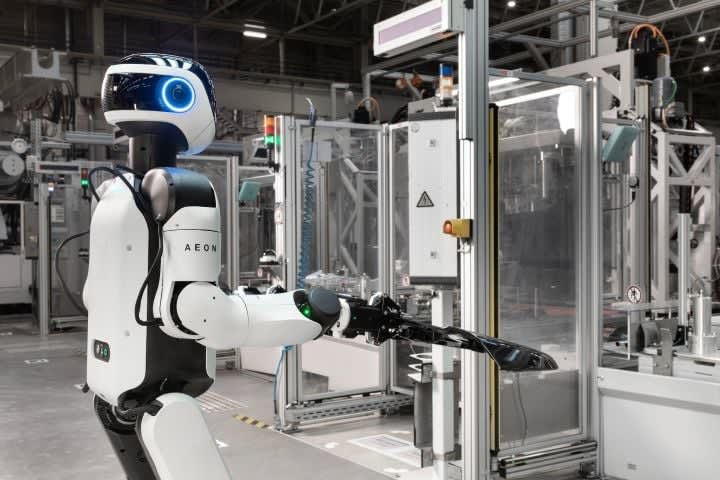
BMW is the latest major automaker to announce a humanoid robot project for auto production.
The German automaker introduced the units as part of a pilot project at its Leipzig plant south of Berlin, following a similar pilot at its South Carolina factory last year.
It said the aim is to integrate robots into existing car series production “and to explore further applications in the production of batteries and components.”
Hyundai announced at the recent CES consumer electronics show its plans to build tens of thousands of humanoid robots per year in partnership with Hyundai Motor Group affiliate Boston Dynamics. It aims to deploy them at its Georgia plant by 2028. Meanwhile, the automaker’s Korean labor union opposes the plan.
Electric-vehicle maker Tesla also plans to manufacture robots, millions of them, ending production of its models S and X to make room for the initiative. The company didn’t say whether any of the units would be used in auto manufacturing but instead focused on robot production itself as it shifts to automation products.
Humanoid robots, in fact, combine artificial intelligence with machines and are therefore referred to as physical AI.
BMW said its robots are intended to improve its production competitiveness.
“The symbiosis of engineering expertise and artificial intelligence opens up entirely new possibilities in production,” said Milan Nedeljković, a member of BMW AG’s Board of Management, Production.
The pilot projects are designed to provide insight for continued development and scaling of physical AI. BMW said it already employs AI in general in nearly all of its production process steps.
“Pilot projects help us to test and further develop the use of Physical AI – that is, AI‑enabled robots capable of learning – under real-world industrial conditions,” said Michael Nikolaides, BMW Group senior vice president production network, supply chain management.
LEARN MORE: Dealership AI Use on the Rise